
I used to think raw chicken in the fridge was a ticking time bomb. Every time I opened the door, I’d glance at the package and quietly wonder — is it okay yet? Is it okay still? My daughter was three years old the last time I accidentally left a tray of raw chicken on the counter while chasing her around the kitchen. I don’t talk about that much.
Here’s what I’ve learned since then: raw chicken is not scary, but it does need a plan. The whole routine comes down to three words — cold, contained, low — and a few small habits that take less time than making a cup of tea.
Before I go any further, one honest note: I’m a registered dietitian by training, but this isn’t a medical consultation. These are the practical guidelines I follow in my own kitchen, drawn from what the CDC, USDA, FDA and a few university food-safety extensions all agree on. For peace of mind, here’s the link to the FDA refrigerator & freezer storage chart“>FDA’s own storage chart.
The short answer, so you can relax
Don’t leave raw chicken at room temperature for more than 2 hours (1 hour if it’s above 90°F outside). Keep the fridge at 40°F or below. Store the chicken on the bottom shelf in a sealed container or wrapped securely, away from anything you’ll eat without cooking. Don’t wash it. Cook or freeze it within 1 to 2 days. Freeze at 0°F or below, thaw in the refrigerator, and cook to an internal temperature of 165°F, checked with a food thermometer.
That’s the whole thing. Everything below is just the reasoning, so you feel less like you’re memorizing a rulebook.
How to store raw chicken in the refrigerator
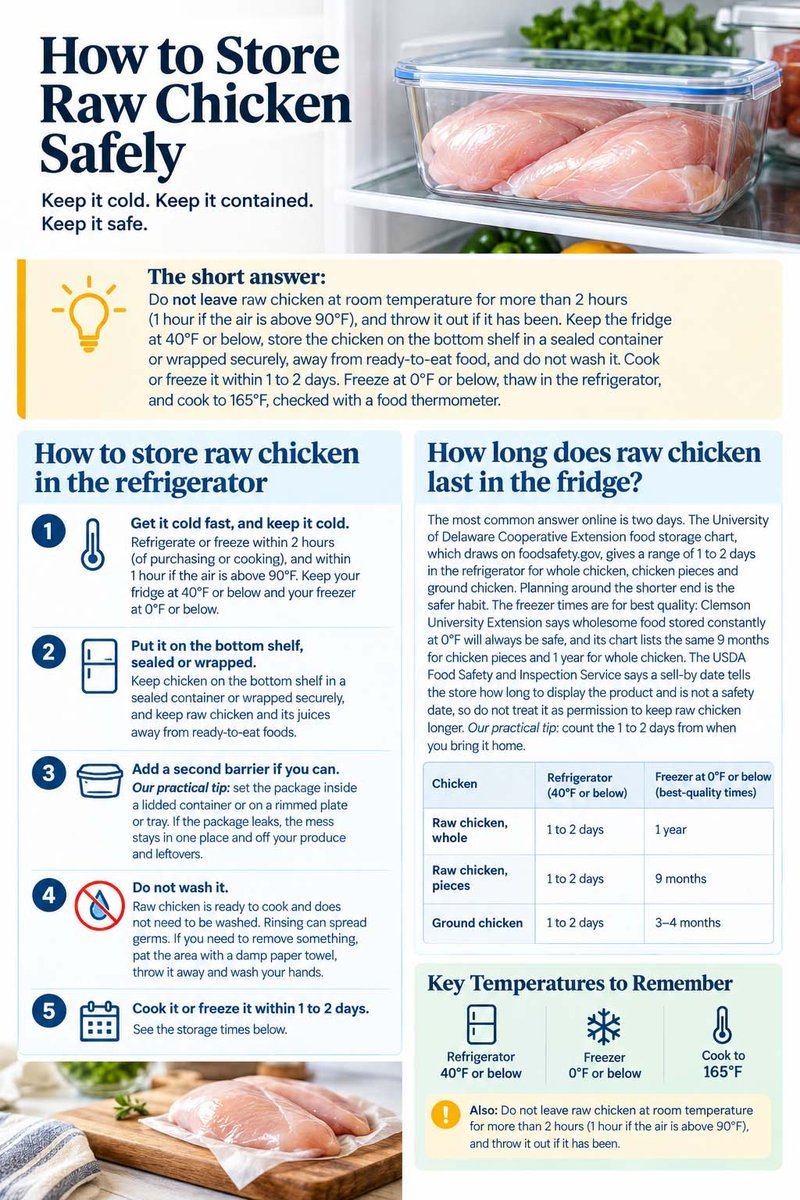
Get it cold fast. The FDA says to refrigerate or freeze meat and poultry within 2 hours of purchasing, and within 1 hour when the air temperature is above 90°F. That includes time in a warm car on the way home. Keep the fridge at 40°F or below and the freezer at 0°F — a small appliance thermometer in each, checked now and then, is worth it.
Bottom shelf, sealed or wrapped. The CDC recommends keeping raw chicken on the bottom shelf of the refrigerator, in a sealed container or wrapped securely, so any juices stay away from ready-to-eat food below.
Add a second barrier if you can. This is the tip I keep coming back to: set the package inside a lidded container or on a rimmed plate. If it leaks, the mess stays in one place — not on your leftovers or your salad greens. It takes five seconds and saves you a whole cleanup later.
Don’t wash it. I know, I know. We rinse everything, right? The CDC says raw chicken is ready to cook without a rinse, and reports that 1 in 7 people who washed their sink after washing chicken still had germs in it. A USDA study found that 60% of participants who washed poultry had bacteria in the sink afterward, and 26% transferred bacteria to salad lettuce. If you need to remove something from the chicken, USDA says to pat the area with a damp paper towel, toss the towel, and wash your hands right away. Skipping the rinse doesn’t replace handwashing or cleaning surfaces — it just keeps the splatter in one spot.
How long does raw chicken last in the fridge?
The most common answer online is two days. The University of Delaware Cooperative Extension food storage chart gives a range: 1 to 2 days in the refrigerator for whole chicken, chicken pieces, and ground chicken. Planning around the shorter end is the safer habit, and it’s the one I follow.
Freezer times are about quality, not safety. Clemson University Extension says wholesome food stored constantly at 0°F will always be safe — their chart lists 9 months for chicken pieces and 1 year for whole chicken. USDA notes that a sell-by date tells the store how long to display the product; it’s not a safety date, so don’t treat it as permission to keep raw chicken longer.
My practical tip: count the 1 to 2 days from the moment you bring the chicken home, not from the date on the package. That’s the number that actually matters in your kitchen.
| Chicken | Refrigerator (40°F or below) | Freezer at 0°F or below (best-quality times) |
|---|---|---|
| Raw chicken, whole | 1 to 2 days | 1 year |
| Raw chicken, pieces | 1 to 2 days | 9 months |
| Raw ground chicken | 1 to 2 days | 3 to 4 months |
Cooked chicken keeps for 3 to 4 days in the refrigerator according to the same chart.
What to do if the package leaks or tears
If the package tears or leaks while the chicken is otherwise safely stored, move it to a fresh, sealed container or bag that won’t leak, and keep it on the bottom shelf. Then clean up properly: the CDC says to wash cutting boards, utensils, dishes and countertops with hot, soapy water, and USDA adds that surfaces that touched raw poultry or its juices should be cleaned with hot soapy water and then a sanitizer. Wash your hands with soap for 20 seconds right after handling the chicken or the package.
One caution I’d rather be annoying about: if juices touched food you’ll eat without cooking — salad greens, deli meat — throw that food out rather than trying to rinse it. It’s usually just a few leaves. Worth it.
How to freeze raw chicken
Freeze chicken at 0°F or below, per the FDA. Supermarket tray wrap isn’t ideal for the freezer — it’s permeable to air. The University of Illinois Extension says it’s safe to freeze meat in its supermarket wrapping, but use it within about two months or overwrap it with heavy-duty foil, freezer wrap, or a freezer zip-lock bag. The National Center for Home Food Preservation says store-bought poultry needs to be over-wrapped because its clear wrap isn’t moisture-vapor resistant. Clemson agrees: overwrap store packages for storage longer than a month or two.
These choices protect quality — they prevent drying and freezer burn, which happens when the surface dehydrates and the fat oxidizes. They don’t change the safety of chicken that stays frozen.
If you buy a family pack, portion it into meal-size amounts before freezing. You’ll thaw only what you’ll actually cook, and the rest stays out of the way. Seal it and freeze it immediately — the longer it sits at room temperature, the less time you have before it needs to be cold.
How to thaw chicken safely
In the refrigerator. This is my default. USDA says allow about a full day for a pound of boneless chicken breasts to thaw this way, and that thawed poultry stays safe for about one to two more days before cooking. Chicken thawed in the refrigerator can be refrozen without cooking, though quality may decline, as long as it stayed cold. Thaw it on a tray on the bottom shelf, because thawing chicken can leak.
In cold water. USDA says the chicken must be in a leak-proof package or plastic bag, the water changed every 30 minutes, and the thawed food cooked immediately.
In the microwave. USDA says to plan to cook right away, since parts of the food may begin to warm into the danger zone.
Never on the counter. USDA says perishable food should not be thawed on the counter or in hot water. Cold-water and microwave-thawed chicken should be cooked before refreezing.
Or skip thawing for some methods. USDA says it’s safe to cook from frozen, which takes about 50% longer than cooking thawed chicken, so use the oven or stove and check the temperature with a food thermometer. For a slow cooker, USDA guidance says all ingredients should be thawed first.
Cook it to 165°F
Refrigeration and containment slow bacterial growth and limit cross-contamination, but they don’t sterilize raw chicken. Cooking is what actually finishes the job. Cook properly handled chicken to an internal temperature of 165°F, checked with a food thermometer, as USDA and the CDC both advise. Refrigerate or freeze leftovers within 2 hours, or within 1 hour if the air is above 90°F.
FAQ
Where should raw chicken go in the fridge?
On the bottom shelf, in a sealed container or wrapped securely, says the CDC. Keep it away from ready-to-eat foods.
Should you wash raw chicken before storing or cooking it?
No. The CDC says raw chicken doesn’t need to be washed first, and USDA says washing doesn’t destroy bacteria — it just spreads them around the sink.
How long can raw chicken sit out at room temperature?
Refrigerate it within 2 hours, or within 1 hour if the air is above 90°F — that can include a hot car. If it’s been out longer than that, throw it out. Refrigerating or freezing it later doesn’t make it safe, and the FDA’s rule is: when in doubt, throw it out.
Can you marinate chicken in the fridge for two days?
Yes. Marinate it in the refrigerator, not on the counter, as the FDA advises, and cook it within two days, per USDA. Don’t use marinade that touched raw poultry as a sauce unless it’s boiled first to destroy bacteria.
What temperature should the refrigerator be? 40°F or below, per the FDA, which recommends an appliance thermometer to check it. If your fridge runs warmer, that’s the first thing to fix before you worry about anything else.
The bottom line
Keep raw chicken cold, sealed, and on the bottom shelf. Skip the rinse. Cook or freeze it within 1 to 2 days. Thaw it in the refrigerator, and cook it to 165°F. That’s it. You don’t need to be a food-safety expert to do this — you just need a plan, and now you have one.
a note from Hazel
I still get a little nervous when I open the fridge and see raw chicken on the bottom shelf. But the nervousness has changed. It’s not “is it okay yet?” anymore — it’s just a quick mental check of the clock, and then I go back to making dinner. The 80/20 version of this: cold, contained, low, and a thermometer in your fridge. That’s enough. That’s always been enough.