
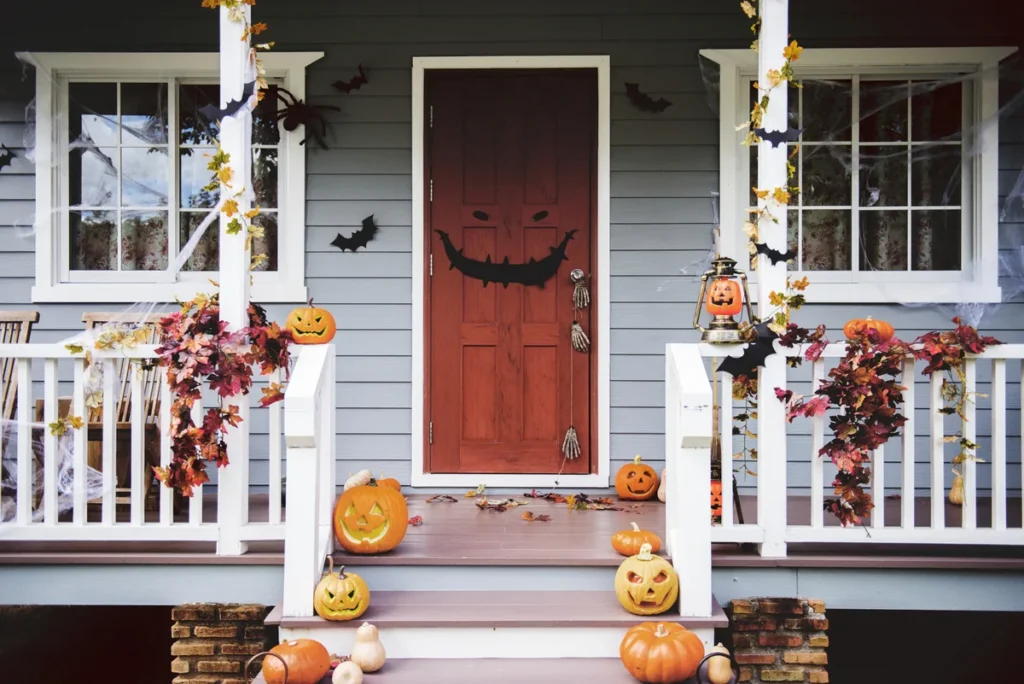
The porch lights came on tonight, and for a second I stood at the kitchen counter with my tea and called the whole thing perfect. My kid saw the first glowing face in the window and forgot whatever we’d been working on. This is the part of autumn I actually love.
I used to think I knew everything there was to know about Halloween — the carving, the lights, the candy bowl, the same walk around the neighborhood every October. Then I started digging into where the traditions actually come from. Not a quiz, a proper source-check: the Library of Congress, the Smithsonian, the National Museum of Ireland, USDA crop data, Guinness World Records. It took longer than I expected, and it changed something about how I see the holiday every year. Fewer of the things we repeat every October are quite as true as we think — and the true ones are stranger.
Where the name actually comes from
The name is younger than the customs. All Hallows’ Eve is the night before All Saints’ Day on November 1 — All Hallows’ Even, then Hallowe’en, and finally Halloween. Merriam-Webster dates the first known use of the word to around 1700, which means the practices around that night go back much, much further.
The other root is Samhain, which in the old Irish calendar marked the beginning of winter, with the celebration landing on the evening before — October 31. The National Museum of Ireland describes it as one of the season’s key markers: protection rituals, feasts, games, pranks, beliefs about spirits, remembrance of the dead. A threshold night, not a costume party. It then folded into Christian observances — All Saints’ Day, which Pope Gregory IV extended throughout the Western Church in 835, and All Souls’ Day on November 2 — and Irish and Scottish immigrants carried the whole mixed-up thing to North America. Halloween has many ancestors. It doesn’t have a single parent, and I like that better.
The turnip came before the pumpkin
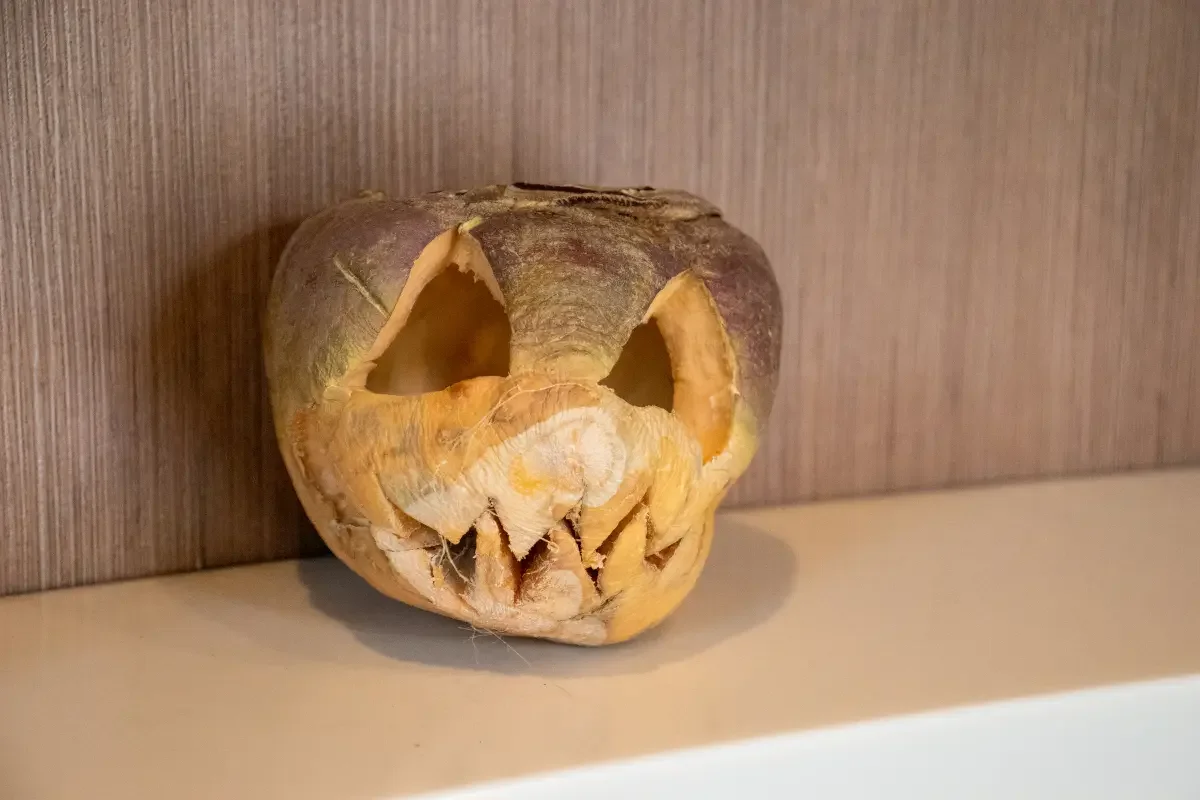
This one I didn’t appreciate until I saw the artifact. The National Museum of Ireland keeps a real carved-turnip lantern: a teacher in County Donegal gave it to the museum in 1943, saying it was the type traditionally made in her locality around 1900. A plaster model of it still stands there as the famous ghost turnip. The face of an actual carved turnip is scarily better than anything in my kitchen.
Pumpkins won the North American version because the crop is native here, and bigger and easier to carve a face into. Illinois is the processing giant — USDA data for 2025 reports about 526.9 million pounds of utilized pumpkin production there. And the world’s heaviest so far is Muggle, grown by twin brothers Ian and Stuart Paton in the UK: 1,278.8 kg (2,819 lb 4 oz), weighed on October 6, 2025, with Guinness World Records confirming it as of this August 2026 update — it also took the record for largest circumference. That is heavier than a car.
Trick-or-treating used to cost a performance
The door-to-door thing has a twisty history. In the medieval period, “souling” meant poorer people going from house to house asking for food in return for prayers for the dead. In Ireland and Scotland, guising meant dressing up and performing — songs, poems, jokes — before anyone handed over a thing. The modern version asks considerably less of the visitor, and I say that as a mom who reuses the same greeting every single year.
The words themselves are recent. Merriam-Webster dates the first known use of “trick or treat” to 1927, with early newspaper examples out of Canada; one of the earliest American examples showed up in a Bay City, Michigan paper in 1928, describing children arriving at doors with “tricks or treats.” Pranks were the real risk — gates going missing, windows being soaped — and organized neighborhood parties grew partly so the next morning wasn’t spent retrieving gates. Sugar rationing in World War II slowed the candy-centered version, and postwar suburbs with individually wrapped everything finally made it click.
It used to be a matchmaking holiday
This is the section I couldn’t stop reading. The Library of Congress holds a whole collection of newspaper pages from more than a century ago showing young people using Halloween to figure out who they were going to marry. One mirror game had you walking backward in the moonlight, eyes on your own reflection, where a future spouse’s face was supposed to appear; another had you staring into a mirror while eating an apple. Apple peels, peeled in one long strip, were thrown over a shoulder and the shape they landed in was read as a future spouse’s initial. Two nuts went into the fire and stood for two people: burn together and the match was promising; jump apart and the prediction changed.
The kale custom, recorded by Robert Burns in the notes to his 1785 poem Halloween, had a blindfolded person pull the first stalk they found in the patch — its size and shape read as the build of the person they’d marry, and the dirt clinging to the root read as that person’s fortune. In Ireland, people baked barmbrack, a dense bread, with small objects hidden inside; a ring meant marriage, other pieces signified wealth, poverty, or staying single. O’ To North Wales there was a darker variant: a legend from Llangernyw told of a figure called the Angelystor, whose voice was said to be heard around Halloween naming the people who would die in the coming year. That’s folklore, not a statistical record — and I love it anyway.
The facts that actually get corrected
Here’s the part most listicles bury — the corrections. These are the claims that circulate every October, and what the sourcing actually says.
“Halloween is just Samhain with a new name.” Too clean. The modern holiday grew out of Gaelic seasonal traditions, Christian observances including All Saints’ and All Souls’ Day, and then centuries of British, Irish, Scottish, and American layering. Many ancestors, not one.
“We know exactly how ancient Samhain worked.” Modern articles describe the ancient Celts with a confidence the surviving records don’t support. What’s documented is real; the precision wrapped around it is often not.
“Stingy Jack is definitely why it’s called that.” The legend of the man who fooled the devil is great folklore. But the term jack-o’-lantern had earlier meanings — a night watchman, a mysterious light over a marsh — and the exact route to carved lanterns isn’t fully documented.
“A stranger killed a kid with poisoned candy.” Sociologist Joel Best has studied the reported incidents for decades: no verified case of a stranger randomly poisoning trick-or-treat candy with death or serious injury has been substantiated. Hoaxes and family crimes happened. The popular story is a different thing entirely.
“Black cats get adopted in October for ritual harm.” A 2026 US study of more than 1,000 participants found that black cats in online shelter photos were rated less likely to be adopted — a real, measurable perception — but superstition itself didn’t explain the ratings, and research hasn’t established the October adoption pattern the legend implies. The cats can still face real disadvantages, which newer work is still investigating.
“‘Samhainophobia’ is a clinical diagnosis.” The word circulates online for intense Halloween fear, but a significant fear would generally sit under specific phobia — it is not its own named condition. It’s a useful label that has outgrown its authority.
“Día de Muertos is Mexican Halloween.” Close dates, overlapping death-and-remembrance imagery — but its own Mexican and Indigenous history, its own religious influences, its own meaning. It deserves to be understood on its own terms, not as a translation.
The weird laws are real (not the way you’ve heard)
These I checked against the actual ordinances, because several of the popular lists name the wrong town or drop a word that changes the meaning entirely.
Belleville, Illinois limits trick-or-treating to students in eighth grade and younger, from 5:00 to 8:30 p.m. — adopted in October 2008. Yes, Illinois. The Belleville in Missouri that some lists name is an unincorporated mining town in Jasper County, also known as Zincite, and it doesn’t have its own municipal government to set the rule.
Rehoboth Beach, Delaware sets the treat window at 6:00–8:00 p.m. for kids under 14 — with one odd twist: if October 31 falls on a Sunday, the door-to-door activity moves to October 30. That’s a detail you don’t make up.
Hollywood, Los Angeles bans possessing, using, selling, or giving away Silly String in places accessible or visible to the public, for the 36 hours running from midnight on October 31 through noon on November 1 — adopted in 2004 after cleanup headaches, vandalism, and safety worries in the big Halloween crowds. I can only imagine the room where that got decided.
Alabama has the so-called priest-costume ban, read carefully: it’s against fraudulent public impersonation of clergy — minister, nun, priest, or rabbi — not against the costume itself. The statute allows up to $500 in fines, up to one year in prison, or both. The word “fraudulently” changes the entire picture.
The money, the movies, the coincidences
Americans planned to spend a record $13.1 billion on Halloween in 2025, per the National Retail Federation — the latest survey as of this August 2026 update, up from an estimated $11.6 billion the year before. Average spending per person hit a record $114.45, above the previous record of $108.24 that’s held since 2023. The breakdown: an estimated $4.3 billion on costumes, $3.9 billion on candy, and pet costumes at $860 million even though only 23% of people planned to dress a pet in the first place. The platform is big, and I respect that there is no 80/20 in the candy aisle.
Culture keeps feeding it. John Carpenter’s Halloween was shot in about 21 days on a production budget of about $320,000; Michael Myers’s face began as a $2 William Shatner mask that a production designer modified until it was blank. Mamie Eisenhower was the first First Lady to publicly decorate the White House for the holiday — October 30, 1958, skeletons, jack-o’-lanterns, corn stalks, and goblins in the State Dining Room. And Harry Houdini really did die on Halloween — October 31, 1926, at 52, from peritonitis after a ruptured appendix. The punches taken in Montreal before he fell ill are part of the story, but the exact relationship is still debated.
What I’m actually doing with all this
I don’t turn the holiday into a production. I buy the lights and a few decorations in the autumn, reuse them for years, and keep a bowl of good candy by the door. The history doesn’t replace any of that — it just adds a layer I enjoy pulling out when the lights go on. In the end, the whole thing is 80/20 is enough: the small rituals that bring my home the most warmth — the carving, the walk around the neighborhood, the tea on the counter — are the part I keep. Everything else is just a good story for conversation, and at this time of year, that is more than enough.
Frequently asked questions
Is Halloween pagan or Christian? Both threads are in it. Samhain contributed the seasonal template; the word itself comes from All Hallows’ Eve, the night before the Christian feast of All Saints’ Day. Everything after that is layering.
When did people start saying ‘trick or treat’? First known use around 1927, per Merriam-Webster, with early newspaper examples in Canada and an American one from Michigan in 1928. The customs behind the phrase are centuries older than the words.
Why pumpkins if turnips came first? The carved-lantern tradition began in Ireland with turnips and other root vegetables. Pumpkins were native here, bigger, and easier to work with — and they simply became the standard.
a note from Hazel: I used to think I’d read the ending of this one long ago. Turns out there’s a museum that keeps a carved turnip’s face, a town where the candy stops at 8:30 sharp, and a horror mask that once cost two dollars. The lights stay on a little longer this year.