

I used to think a calm home had to look like a spa catalog. Cream walls, quiet textures, nothing that asked for your attention. If it had a pattern, it had to be subtle. I’ve spent enough mornings staring at my own living room, wondering why I never feel relaxed in it, to know I was wrong.
What I’m actually drawn to lately is a little bit of joy. Something that makes me stop and look twice. Which is exactly why I’m telling you about a book that landed this week and completely changed my idea of what a beautiful room can be.
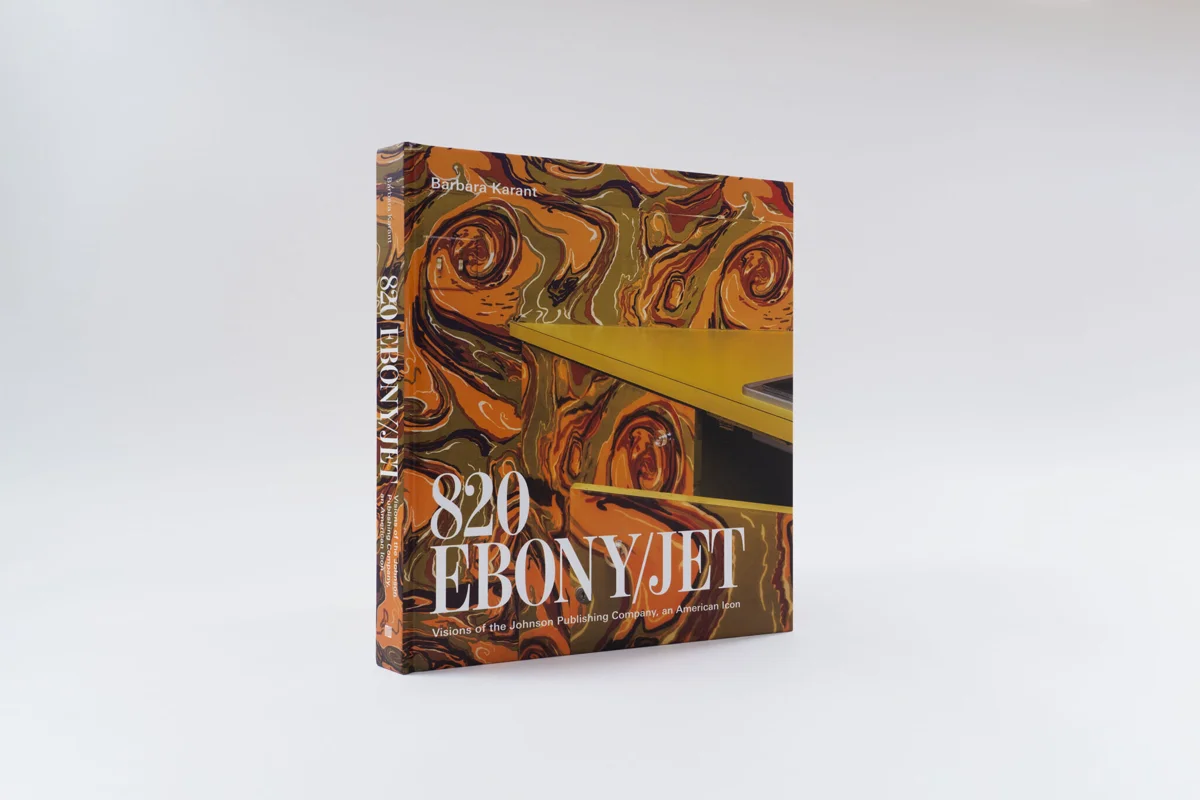
The book is 820 Ebony/Jet: Visions of the Johnson Publishing Company, an American Icon, and it’s about one of the most striking office buildings ever made in the US.
The building behind the book
For decades, Ebony and Jet were two of the most important publications documenting Black American life and culture. Johnson Publishing Company, which published them, was the era’s most influential Black-owned media corporation. In 1972, its headquarters opened at 820 South Michigan Avenue in Chicago, and it gave that cultural work a physical home.
The story of how that building got built is a good one. Publisher John H. Johnson faced resistance from real estate agents and bankers who were nervous about financing a Black-owned company. So he did the smart thing and commissioned John Moutoussamy, the first Black architect to design a downtown Chicago high-rise. Johnson didn’t want another glass-and-steel tower. He wanted something with permanence and character, and Moutoussamy delivered a restrained exterior clad in travertine marble.
And then, once you got inside, all of that restraint went out the window.
Inside the 1970s headquarters
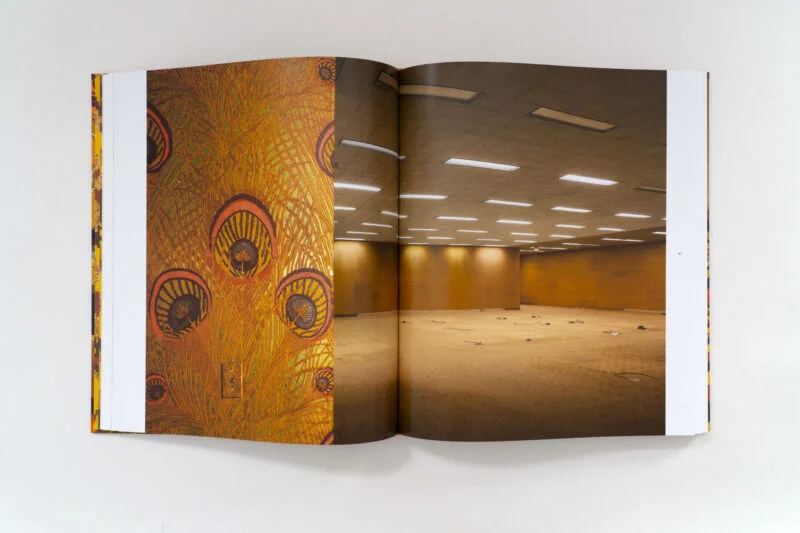
The interiors of the building were designed by Palm Springs designers Arthur Elrod and William Raiser, and they gave each of the building’s 11 floors its own combination of color and pattern. The cafeteria paired orange, purple, and gold chevrons. Co-founder Eunice Johnson’s office was cream and honey, filled with pieces from the couple’s art collection. Geometric wallpaper, mirrored surfaces, bold carpets, and richly patterned finishes showed up everywhere.
Remarkably, most of that design stayed untouched until Johnson Publishing Company left the building in 2012. The next year, photographer Barbara Karant started photographing the empty headquarters, and she kept going through 2018. With the furniture gone, she focused on the surfaces and details that defined the space: the geometric wallpaper, the mirrored dressing rooms, the swirling laminate cabinetry in what was called the Test Kitchen, whose psychedelic patterning recalls Italian marbled paper.
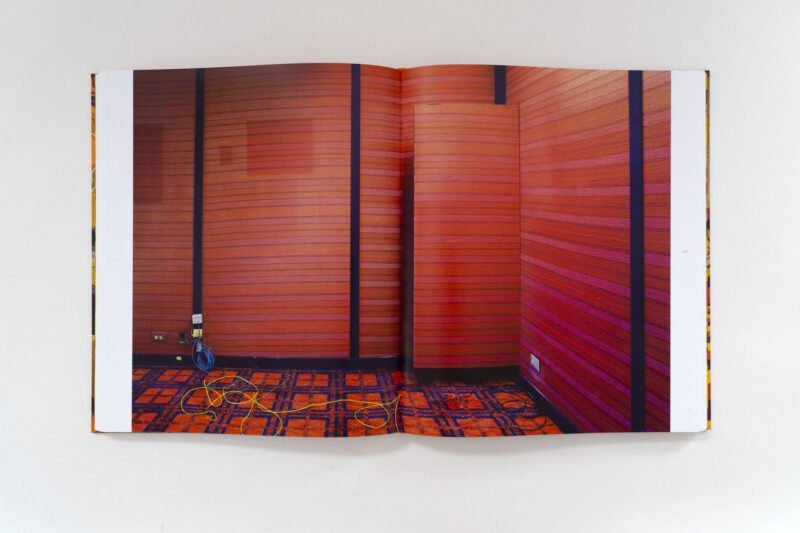
Mirrors double and multiply patterns throughout her compositions, and the picture windows on the executive floor pull Lake Michigan and Grant Park into view. The building’s emptiness is part of what gives the photographs their power. Stripped of the people and the day-to-day activity that once filled it, the rooms become studies in color and pattern. But they’re also records of a workplace and a cultural institution that no longer exist in this form.
What’s actually in the book
The book broadens that record. It includes documentary images of the original interiors and Ebony‘s in-house photo studio, plus Richard Hunt’s site-specific lobby sculpture Expansive Construction (1972). Former employees share firsthand accounts of life inside the building, and the book traces its influence on artists including Theaster Gates, Hank Willis Thomas, Kwame Brathwaite, Lorna Simpson, Martine Syms, and David Hartt.
At 240 pages, it brings together 142 color images and eight black-and-white images, with a foreword by artist Deborah Willis and essays by Aaron Bryant, Cheryl Finley, Carla Williams, Jon Ott, Brenna Wynn Greer, and E. James West. Published by MW Editions, 820 Ebony/Jet is available October 13 for $65. You can find it at the Design Milk article covering the release.
Why a wellness reader should care
Here’s the thing I keep coming back to. We talk a lot about creating spaces that support our nervous system. Quiet, uncluttered, neutral. And all of that is genuinely useful. But this book made me wonder if we’ve leaned a little too hard into ‘calm’ and accidentally left out ‘joy.’
You don’t need an entire room covered in chevron wallpaper to borrow from it. Maybe it’s one wall. Maybe it’s a single bold patterned textile in an otherwise simple room. A pattern that makes you smile when you walk past it is doing the same job a soft neutral wall is doing: it’s telling your brain this is a place you can exhale in. 80/20 is enough. You don’t have to commit to the whole kaleidoscope.
If you’re the kind of person who keeps a book on the coffee table not to read it but to look at it, this one earns its place. It’s a quiet book about a loud, colorful building, and honestly, I think my home could use a little more of that.
a note from Hazel
I’ve been thinking about that Test Kitchen with its swirling cabinets every time I’ve opened a cabinet door at home this week. Some of it is just a photo book about a building that’s mostly gone. But some of it is a permission slip. And right now, I’m taking it.