

I used to think a hobby was something you did right. A clean practice, a tidy schedule, results that looked like progress. Then I read about a textile artist in Los Angeles who spends her days at a design job and her evenings turning a sick room, a wildfire season, and a bag of chip wrappers into art. Her name is Hannah Buechler, and she made me rethink what a creative practice is actually for.

Hannah was 13 when she spent hours in her mother’s garage, painting with her hands and making a mess. “I realized then — and I still believe this to be true now — that making art was what I enjoyed most,” she told me. She studied fibers at the Savannah College of Art and Design, and now runs her own studio in LA, making tactile collages from small, repetitive gestures that grow into complex layers. She’s the daughter of a scientist, which explains a lot: she thinks hard about where her materials come from and what they can become. Resin, embroidery, painting techniques — if it exists, she has probably tried mixing it with something else.
She also has a 9-to-5. For the last five years, she’s been a senior designer at Libertine, an apparel company, working in patterns, screenprinting, and digital graphics. “I have always had a creative corporate job while continuing my studio practice,” she says. That balance struck me, because it’s exactly the 80/20 version of a dream I keep avoiding: not quitting everything for art, just letting art stay alive in the cracks.
So she shared five things that inspire her. Here’s what I took from each one.
1. Music, in full albums
Music is a driving force in her work — so much so that she names pieces after song titles. She doesn’t shuffle. She listens to whole albums, front to back, so she can hear how a song transitions into the next one and understand the style behind each artist’s record. Her taste is all over the place: heavy metal, rap, pop, rock, indie. One day, she started her morning with Electric Light Orchestra, then switched to Candlemass and Ariana Grande.
I shuffled everything for years, and I think it cost me something. A full album is a small commitment, like a walk outside with no destination. You let one mood carry you into the next.
2. Experimenting, including the ugly ones
Experimentation is where her learning happens. She blends processes and materials so freely that she makes her own textiles, including what she calls loom bands. Resin, embroidery, painting techniques — over the years, all fair game.
One project she hasn’t released yet is called Freshman 25. As a freshman, she collected chip bags and microwaved them. She has around 100 of them now. Until she figures out how to mount them, she’ll keep them to herself — but it’s a project at the back of her mind that she knows she has to finish.
Hundred chip bags, no plan. That’s the part I need to steal. I over-plan my hobbies until they feel like assignments. A hobby that keeps a drawer full of experiments is a hobby that stays alive.
3. Fashion, learned from the grown-ups
She has loved clothes since she knew how to dress herself. Her parents both appreciated fashion, so she grew up watching how they dressed, and it always made her want to look good and feel good in her own clothes. Working in fashion for the last five years didn’t surprise anyone who knows her.
Even as a kid, she was moved by specific collections — Karl Lagerfeld’s Chanel Pre-Fall 2012 Paris-Bombay and Pre-Fall 2014 Paris-Dallas, all of Alexander McQueen’s work from the theatrical sets to the clothes (No. 13 Paint Dress Finale, Spring/Summer 1999). And growing up, she loved feeling the colorful textiles in department stores, especially the Chanel tweeds.
Fashion is where my own story is similar: I learned to eat well by watching what my family put on the table, and I learned to dress well the same slow way. The clothes you loved at twelve are still good data about you.
4. Collecting small, honest things
She has a knack for collecting. A white Panasonic VHS TV, “tape towers” built in the corners of her room, cigar boxes holding colored pencils, pencil shavings, pens, paint scraps, resin scraps. As a kid, she started collecting vinyl after being gifted The Beatles’ Magical Mystery Tour and Sgt. Pepper’s Lonely Hearts Club Band, plus The Rolling Stones’ Undercover. Her newest obsession: Kieselstein-Cord handbags — a niche, ornate brand with gold, animalistic details, like crocodile feet on the bottom of a bag.

Collecting sounds indulgent, but it’s really just paying attention. My version is a drawer of spare teabags, a jar of good paperclips, a shelf of books I keep meaning to start. No one is grading the drawer.
5. Stevie, the Boston Terrier
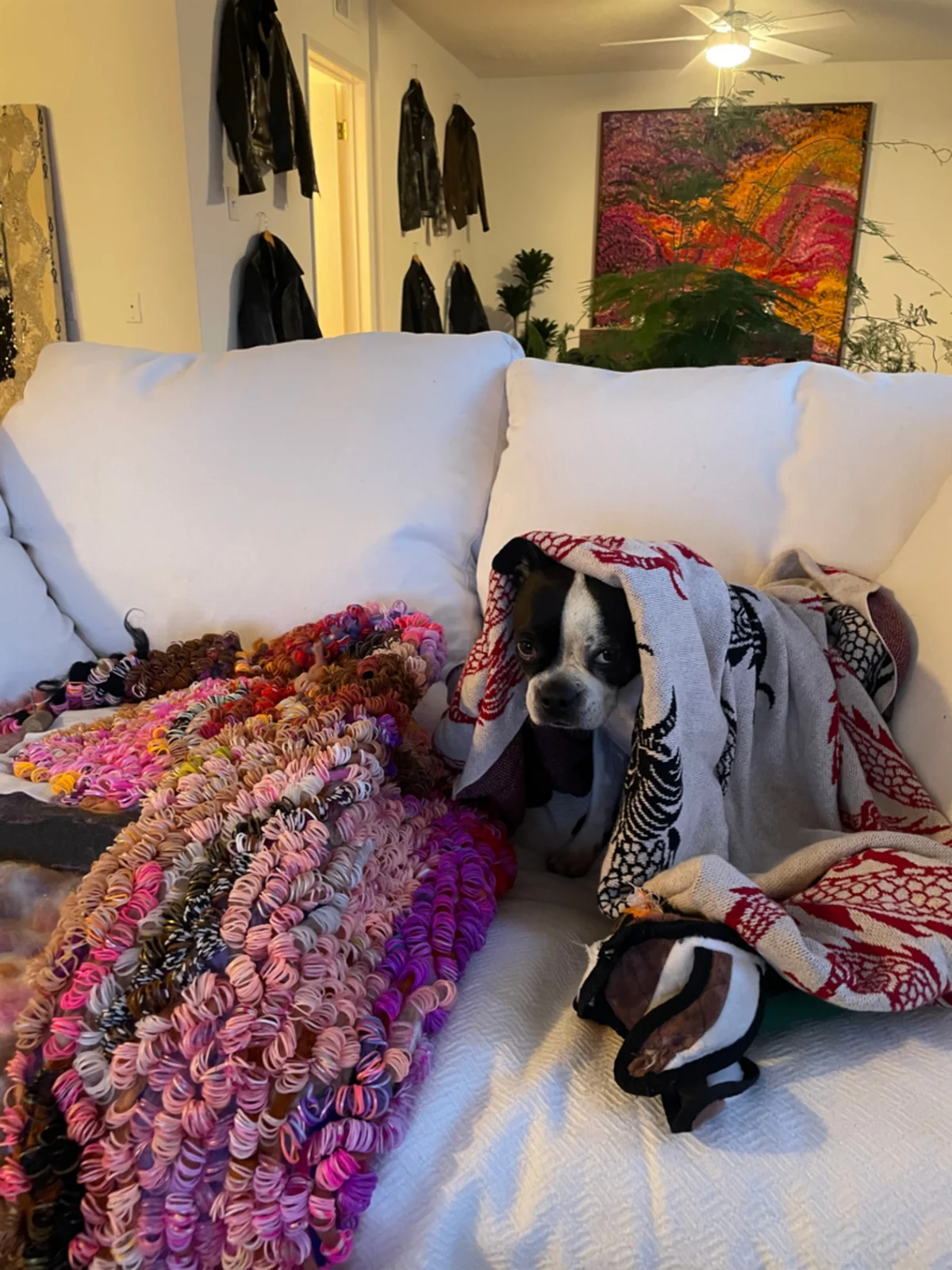
Stevie — Steve to some people — is her 9-year-old Boston Terrier, who has followed her all over the world. Savannah to Paris, San Diego to New York, now Los Angeles. South America, all over the United States. The best and easiest travel companion she has, despite a stubborn personality.
She’s the strangest, quirkiest dog, incredibly bright and silly at the same time. She has a funny way of understanding the materials Hannah is working with and what she can step on: she will walk around a wet painting on the floor without a second thought, but she will also walk and sit right on the loom band pieces. A dog who has opinions about your art process is exactly the kind of accountability partner I want on my mornings.
Five projects that made me reread the word “hobby”
Then she walked me through five of her favorite projects, and each one came with a life moment attached.
Cosmos. The culmination of saved experiments from college, extensive beading with broken jewelry, and themes of deconstruction and reconstruction — a large (63 x 48 inches, roughly 160 x 122 cm) free-standing artwork that can also be wall-mounted. She started it while sick and quarantined with COVID. She had never watched Euphoria, so she binge-watched two seasons and beaded from her room, with no idea how large it would become. Over the four years she spent on it, it grew from a small beaded textile into an endless artwork: loose material embedded under mesh layers, chain woven between rows of safety pins, pieces of a beaded, broken vase dipped in resin. It made her think about time capsule pieces for other people — someone who doesn’t want to throw out certain textiles, materials, or jewelry. She looks at it every day, and she’s starting to see shapes form in it.
Palisade. Made during the 2025 Los Angeles fires. She needed to create something to cope with the disasters around her. The composition came from the drive home the day the fires started, watching flames rise off the mountains beneath the Getty. Growing up in San Diego, she remembers evacuations, a town full of eucalyptus trees that always pose a threat, and the grayish-black thick skies with a hint of yellow and orange depending on how close you were to the fire. With Palisade, she wanted black, grays, and white with bright, striking hues — a little moment in the bottom right corner for the drastic color change before and after the fire. Her partner and she decided to stay in LA, despite living at the base of the Santa Monica Mountains. Her partner is a fashion designer who makes custom clothes for rock ‘n’ rollers like Billy Idol, and they spent days figuring out how to get their work out of the house. Her family offered to drive up and help move the things they couldn’t bear to part with. When it came to leaving larger pieces behind — like Cosmos, still a work in progress — she chose to stay. Staying is what gave her Palisade: something that symbolized a moment in time.
Alaska. A commission that turned out better than she had hoped. A woman hired her, and the fabric substrate printed the fish her husband had caught — a record made using gyotaku, a Japanese fish-print technique that captures an exact, lifelike image of a catch before the fish is sold or eaten. Coincidentally, she took the project on a fly-fishing trip to Alaska with her family, and that’s when she started seeing the connection between fly-fishing and beading. Beyond the materials she works with — fishing line, lures, flies — both are very patient processes. The commission took 11 months. When it was framed, she wanted the backside beading visible too, so she had a piece of plexiglass laser-cut with holes around the edge, sewed the fabric into the base of the frame with fishing line, and added fishing lures and beads to hold it in place.
Contemplation / The Weight of Memory. As the daughter of a biochemist, she grew up fascinated with the human body — and with a real human skeleton in the family home, named Walter, who probably should have scared her but instead became a source of inspiration. Her first body of work was when she was 17, in high school: different parts of the body, a different technique in each piece. These two framed loom band pieces were her way of bringing the body back into her loom band work — and a big challenge, because they meant letting go of the freestyle approach she loves. She planned and redrew the faces a lot, the opposite of how her other work flows.
Wild Like the West Texas Winds. Painting is where she gets to be more expressive and representational. Since color, line, and texture drive her loom band work, her paintings give her a moment to reflect on gradients, repetitive patterns like stripes, camo, and animal prints, flora and fauna. She completed this one in 2019, and it remains one of her favorite paintings because of the time she made it in. The name came from one of her grandpa’s many quotes he used to describe her. When she painted it, he had just been admitted to a nursing home. She would go to work every day, visit him, and come home to paint. This was the piece she became obsessed with coming home to. She has tried to make something similar since, and it always ends up too chaotic. WLTWTW will always be special to her in many ways.
The Morning Reset version of all this
Five minutes, three shifts:
- Play one whole album. No shuffle. Let it take you somewhere on its own terms.
- Keep one drawer of experiments — the messy, unmounted, not-ready stuff. A hobby that can’t be messy is a hobby that can die.
- Attach your hobby to a real day, not an ideal one. Hannah made Palisade during a fire and Cosmos while sick. The art didn’t wait for calm weather, and neither does mine anymore.
FAQ
Where can I see Hannah Buechler’s work? She’s based in Los Angeles and runs her eponymous studio. The projects she shared — Cosmos, Palisade, Alaska, Contemplation, The Weight of Memory — were photographed by Spencer Higgins and Julia Deptula, and the full interview ran on Design Milk.
What are “loom bands”? They’re handmade bands of woven textile that Hannah makes herself — part of her signature studio work, the small repetitive gestures that build up into rich textures.
Do I need a 9-to-5 to have a creative practice? No — but a day job is the least glamorous, most sustainable version of the thing. Hannah has balanced her studio with a design job her whole career, and it’s exactly the kind of arrangement that keeps the work alive without burning it out.
a note from Hazel
I’m still a long way from 100 microwaved chip bags. But I kept her Freshman 25 in my head all day, and I think that’s the whole point: a hobby isn’t a second job. It’s the part of the day that’s allowed to be unfinished. 80/20 is enough — even for art, especially for art.